For a deeper look into the urgent biblical call to true repentance and readiness in these perilous times, read this document in full here: Repent Now; He loves you.
Just One More
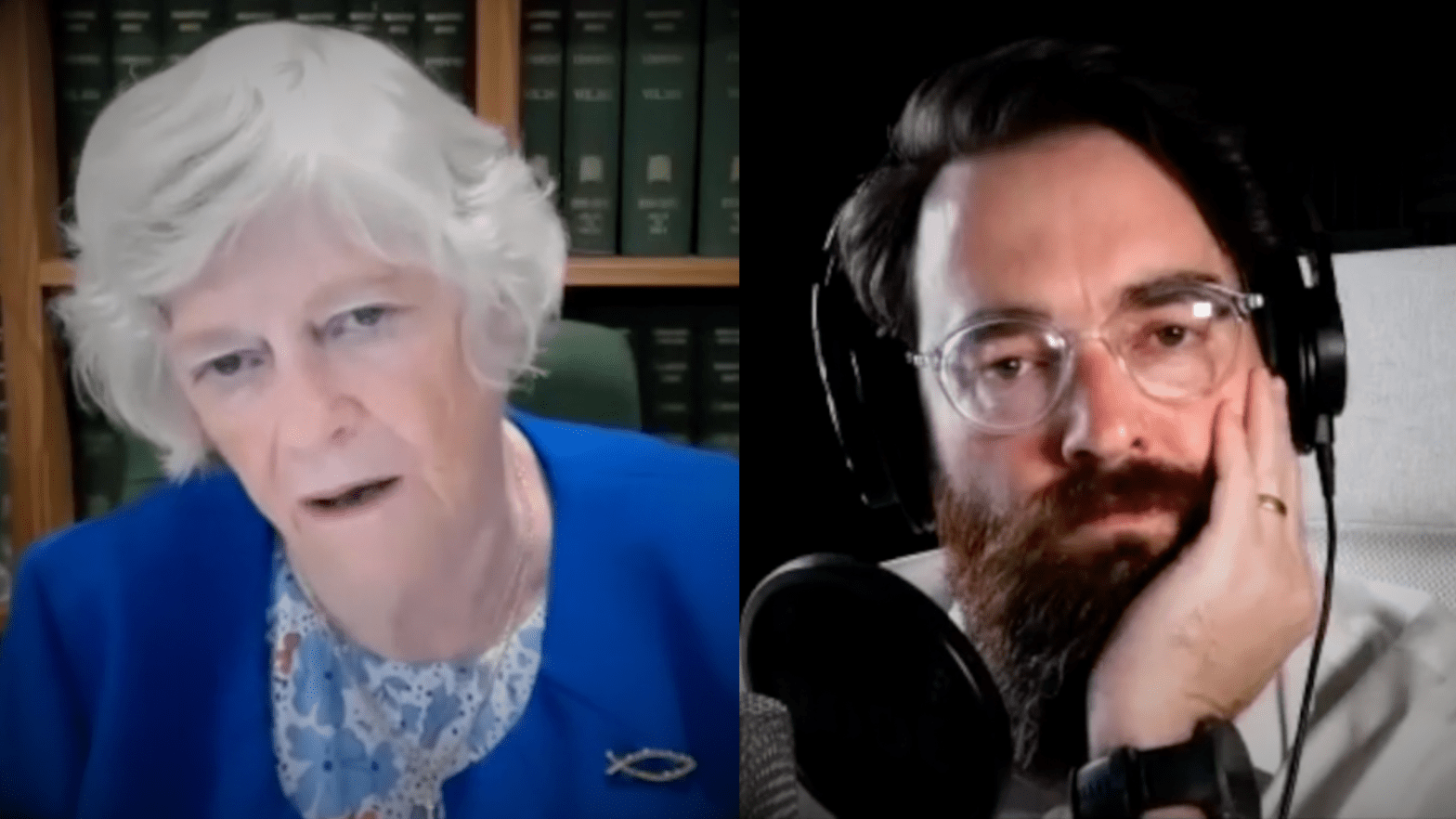
There was never any danger of Ann Widdecombe blending into the background. Whether commanding the floor at Westminster, navigating the political fractures of Brussels, or sitting before a microphone to dissect the spiritual state of Great Britain, she spoke with a rare, diamond-hard clarity. To look back on her two extensive interviews on the Into the Pray podcast is to remember a woman who entirely rejected the modern gospel of comfort and political correctness.
But beneath the sharp, familiar cadence of a seasoned statesman was a heart deeply anchored by a specific, poignant visual and one that, in light of tragedy, now feels like her definitive parting challenge to us all.
The Antidote to a Complacent Church
In her conversations with me, Ann did not mince words about what she diagnosed as the “cowardice” of the modern church. To her, the chaos wasn’t a logistical problem; it was a moral one.
“I don’t think the Church’s problem is so much chaos as it is cowardice,” she stated bluntly. “The church no longer speaks out… it wants all the time to be seen to be politically correct.”
She looked back to the early church as her North Star, a community that risked execution, crucifixion, and exile to declare an uncomfortable truth to a hostile world. By contrast, she lamented how easily modern believers are cowed by nothing more than “strong social disapproval.” Ann fiercely admired Christ because He scandalised the establishment, overturned the tables, and refused to measure His words to soothe the culture. For Ann, to live out a Christian faith meant accepting the risk of being unpopular, cancelled, or disliked, so long as one remained faithful to the truth.
This is extremely poignant today in light of tragic and deeply disturbing events this week on Dartmoor .
While we must note the historical caveat that she held firmly to Catholic conviction—which we consider altogether false—her critique of modern compromise remains biting.
The Prophetic and the Practical
As an old-school campaigner, Ann understood the grinding, patient nature of reform. When discussing the Old Testament prophets like Isaiah and Jeremiah with me, she agreed with my polemic concerning the impossibility of holding tension between being prophetically correct and politically correct.
She knew the frustration of the slow road. She frequently cited her heroes, William Wilberforce and Winston Churchill, noting that their greatness lay in one simple trait: they never gave up, and they never changed the message.
Yet, for all her experience operating on the grand stage of national politics and state institutions, Ann’s ultimate conclusion was that institutions would not save us. The state would not bring revival, and the established church structures were too compromised by a desire to please the world.
This is what the Bible emphatically and consistently calls spiritual whoredom and adultery. Study this with urgency here, knowing that none of us are guaranteed tomorrow.
The Law of Hacksaw Ridge
This is where Ann’s fierce exterior gave way to something profoundly moving. In both interviews with me, separated by months of global upheaval, Ann anchored her entire theology of Christian action in a single cinematic image: the real-life story of Desmond Doss on Hacksaw Ridge.
She recounted with immense emotion the image of the lone combat medic, facing an impossible landscape of slaughter, pulling wounded men to the cliff edge one by one.
“He didn’t say, ‘Let me save all these wounded men, oh Lord.’ He didn’t say, ‘Bring down a miracle and let them all walk towards me.’ He said the one thing that he could do. What he was asking God for was just one more. And he must have said that 75 times: just one more.”
For Ann, this was the ultimate antidote to the despair of watching a society slide into spiritual illiteracy and moral bankruptcy, all the while the Church stood idly by — she implored us to stop paralysing ourselves by trying to fix the whole world all at once. Instead, she begged the Church to adopt the prayer of the ridge: Lord, just give me one more. Let me bring just one person to you this week.
A Lasting Echo
In revealing her inner motivations, Ann openly admitted to a tension in her own prayer life. She confessed that she prayed daily for the return of Christ to end the unleashed wickedness on earth, while simultaneously praying, “Oh dear, I hope He doesn’t come tomorrow, because we have such a job to do.”
It is here that a vital scriptural correction must be made. The eschatological heartcry of the Lord’s return is not tempered, in the New Testament, by any noble desire for evangelism. The primitive Church never viewed the gospel commission as a reason to delay or soften the Maranatha cry; rather, their urgent proclamation of truth was entirely driven by, and secondary to, the imminent expectation of His appearing.
Ann has now run her race, standing resolute until the end, completely unashamed of the Gospel. As we navigate the weight of tragedy and the silence left in her absence, the echo of her voice challenges our complacency. She leaves us not so much with a political manifesto or summons, but with the battle cry of a servant who knew that every single soul matters when this life finally concludes.
“Let us not look to success, but to endeavour. And let us always say: Just one more, Lord. Just one more.”
For a deeper look into the urgent biblical call to true repentance and readiness in these times, read this document in full here: Repent Now; He loves you.


Do you believe Ann was saved Nicholas ? Her murder was heartbreaking , but how can one hold fast to the teachings of Rome and enter heaven ? If you add to Christ you are surely severed from grace . Jesus + nothing is everything.
As with the late Queen Elizabeth (or anybody else who is caught up in the apostate Church), I don’t know, David…nor do you. But if you’re suggesting that I’m somehow promoting a liberal laissez faire view of Catholicism, you might do a bit more leg work and, in so doing, show a tad more respect in both death and in life. 👇
Nick that was never my intention, it was an honest enquiry as you were acquainted with Ann and maybe had some greater insight. Ann’s murder grieved me and i truly hope her hope was in Christ alone .
Only found your channel and writings today and find myself in agreement with all I’ve read so far .
Shalom .
It didn’t read like that, David. It’s a difficult job sifting and discerning where people’s comments are coming from. So please forgive me for getting this wrong. I spent several hours podcasting with Ann and admired her very much. What a despicable world we live in. Our hope is in Christ alone, and the love of His appearing (2 Timothy 4:8) spreading via repentance through His renegade bride. Thank you very much. I pray that these two seminal links from our training of anguish are significant for you also: https://firebrandnotes.com/2026/02/04/confession/ because https://firebrandnotes.com/wp-content/uploads/2024/11/i-am-jealous-ebook-final.pdf
No problem brother , with hindsight I understand how my original comment could come across as slightly uncharitable, truth is I’ve always held Ann in such high regard and admired her courage in the public square.
Thanks for the recommendations.
👍